What You Need to Know: Type 1L Cement Panel Discussion Recap
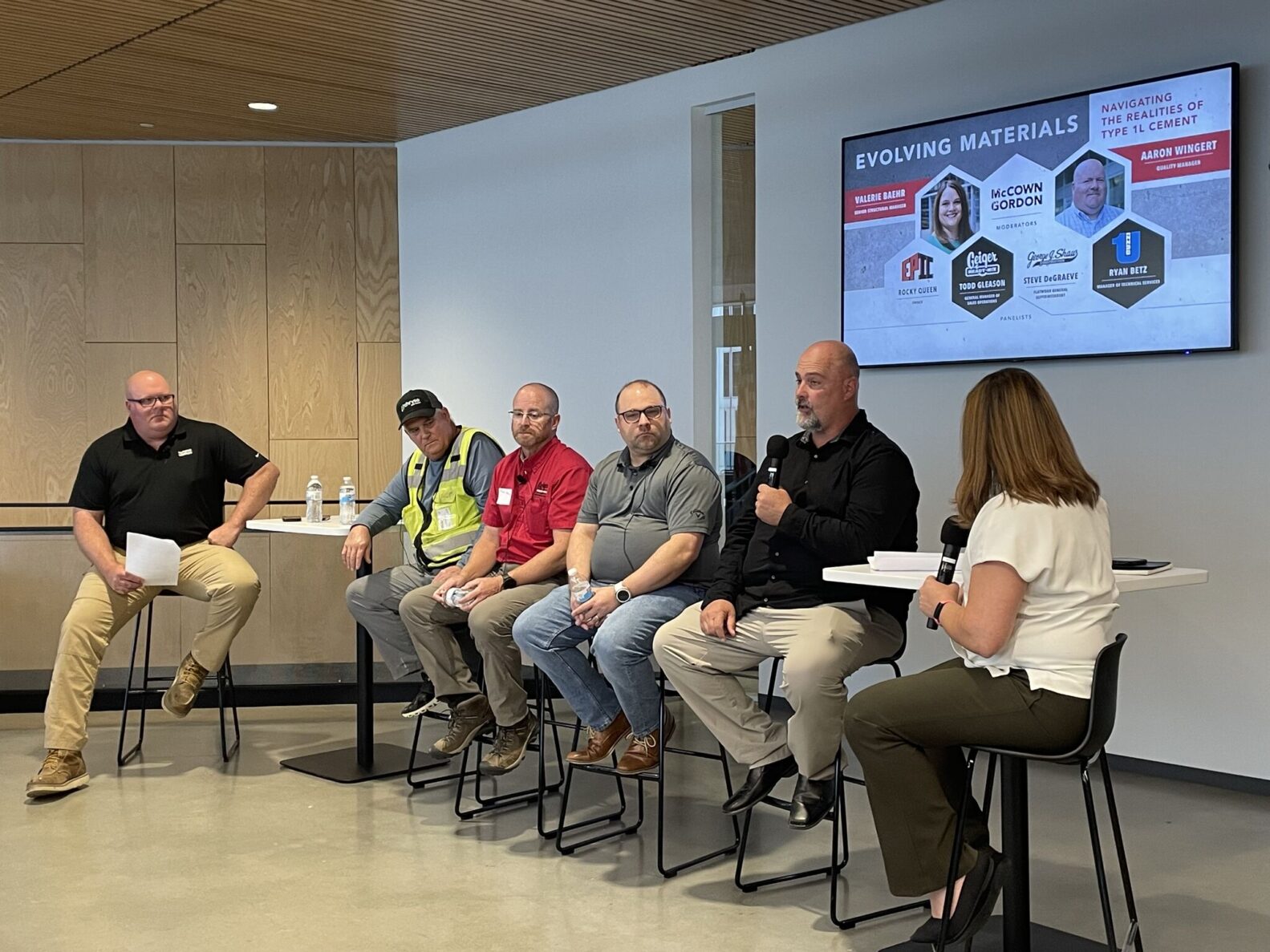
“It’s extremely challenging for finishers right now, mentally and physically, just trying to get a good cement mix. It’s not that we don’t know what we’re doing; it’s that something has changed,” said Rocky Queen, Owner of Epic at the recent Type 1L Cement Panel discussion, hosted by McCownGordon Construction.
The shift to Type 1L Portland cement is reshaping how the Architecture/Engineering/Construction (AEC) industry approaches concrete design, construction, maintenance and long-term performance. Concrete doesn’t behave the way it did just a few years ago, and that’s creating new challenges in how we place it and protect it against the harsh climate we see in Kansas City. These changes have implications for concrete durability, warranties and the potential for costly rework.
In a panel moderated by Aaron Wingert and Valerie Baehr, members of McCownGordon’s Building Performance Solutions team, industry experts discussed how they are actively navigating this change. Our panelists shared key lessons learned, practical strategies and evolving best practices to help guide clients and project teams through the complexities of Type 1L cement.
THE SHIFT TO TYPE 1L CEMENT
Type 1L cement was introduced to the Kansas City market in 2022, a shift which is occurring nationwide as a defining step to reduce carbon emissions in materials production. “We’ve been moving toward reducing embodied carbon in the built environment, and it’s widely understood that most carbon emissions associated with concrete construction come from cement. This makes cement the biggest opportunity for improvement, which is why the development of Type 1L has been so important,” said Ryan Betts, Manager of Technical Services at Buzzi Unicem.
While the initial change was thought to have little impact beyond a slight delay in strength gain, not long after the switch, Todd Gleason, General Manager of Sale Operations for Geiger Ready-Mix, noted they started receiving calls about challenges with finishing the new concrete including cracking, scaling and delamination. Initial thoughts pointed to the time of year and the difference in humidity and wind, however, the call frequency and volume only increased.
CHALLENGES WITH TYPE 1L CEMENT
The introduction of Type 1L brought significant changes to concrete performance, with noteworthy issues in concrete flatwork emerging in early 2025. The core issue lies in its greater susceptibility to environmental conditions impacting evaporation and drastically reduced the finishing window, leaving little room for error. Unlike traditional mixes, which produce visible bleed water, Type 1L often shows only a slight sheen, making it difficult for crews to gauge timing for finishing slabs. “The previous mixes were more forgiving, and now we have a small window to get it right,” said Queen. Without proper finishing techniques, this new mix can develop shrinkage cracks, lose polish quality and become difficult to rework once setting begins. In extreme cases, slabs have also experienced full delamination of top surfaces. Crews must follow strict guidelines and adapt their approach because old methods don’t work with the new Type 1L.
In the Kansas City Market, the limestone content of Type 1L cement increased from 8% in 2022 to 11–12% by the end of 2024, exacerbating issues finishers had noted early in the switch to Type 1L. The finer make-up of the crushed limestone limits bleed water from rising to the surface, forcing finishers to rely on finishing aids and admixtures. While these can help, and can even be important components, improper training has led to misuse of evaporation retarder, resulting in increased water/cement ratio at the finished surface and compromised surface durability. In the winter of 2025, the Kansas City area saw the perfect storm of very harsh weather, improper maintenance and less durable concrete surfaces. As a result, spalling, pitting and delamination of site concrete’s surfaces became widespread in projects placed in 2024, whereas earlier years saw fewer issues.
Queen explained another major issue with the new mix involves the use of super salts for snow and ice removal. These salts work even in extremely low temperatures, which has led municipalities and school districts to apply them heavily. Then, instead of clearing snow completely, maintenance crews often pile it along sidewalks, exposing the concrete to degradation from the salt. This combined with the repeated exposure through hundreds of freeze-thaw cycles throughout the year causes damage in those areas of snow piles and heavy traffic, even when the rest of the site concrete remains in good condition. The problems are often concentrated on areas where snow and salt were left. To prevent this, municipalities and school districts should train crews to remove snow fully rather than leaving piles along edges. Additionally, when weather clears, any remaining salt should be broomed or washed off the concrete curbs, sidewalks and other paving.
Type 1L cement has introduced a steep learning curve. Crews must adapt to new practices, monitor evaporation forecasts and apply finishing techniques with precision to avoid costly defects.
SOLUTIONS & LONG-TERM OUTLOOK
The industry is in a transition phase as contractors, architects, engineers and producers adapt to the unique behavior of Type 1L cement. Key issues like late bleed and surface dehydration have led to surface porosity and freeze-thaw damage. The focus is shifting from trying to increase bleed water to maintaining moisture within the mix for better finishing and durability. Solutions include mix design adjustments, using rheology-modifying admixtures and strategies to reduce evaporation and improve surface density.
Regional challenges vary widely—Texas struggles with evaporation, while Kansas and Missouri face challenges from both evaporation and freeze-thaw damage and delamination. “The biggest factor I’ve seen in whether people succeed or struggle is how well they reinforce the fundamentals—the good practices we’ve known for years,” said Betts. “Things like proper mix design, material selection, placement and finishing. Those who consistently do these basics well tend to avoid most problems.” Local groups and suppliers are conducting mockups and tests, adjusting variables like admixtures, water-cement ratios, and finishing techniques to refine best practices, with data collection and analysis.
Contractors are adopting new measures to combat evaporation, such as monitoring daily forecasts and adjusting schedules. Recommendations include using straight cement in slab mixes instead of supplementary cementitious materials (slag or fly ash), adding accelerators and incorporating admixtures to reduce plastic shrinkage cracking. “We’ve been using VMAR 3 (a rheology-modifying admixture) for about 15 months, and one thing we’ve noticed is its effectiveness,” said Steve DeGraeve, Flatwork General Superintendent at George J. Shaw Construction. “Previously, pouring exterior paving on challenging days was risky, but now we can handle evaporation rates up to 0.15–0.20 without issues. It’s extremely helpful—about 99% effective for exterior work and 60–70% for interior floors.”
Long-term success will depend on proactive maintenance programs. Current strategies involve using admixtures, admixture-sealers, cure-and-seal products, post-applied sealers and densifiers. “Sealing concrete is not a new concept, but it is a heightened need now,” noted Gleason. As DeGraeve added, “We use these methods on a daily basis, so we don’t sit in meetings on the post end of a project having to explain what happened.” While these adjustments increase costs and complicate timelines, they help prevent defects and protect quality—critical for maintaining reputation in a competitive market.
THE BIGGER PICTURE
Type 1L cement represents a significant step toward sustainability, but the transition has brought its share of challenges. Success hinges on proactive planning and clear communication. As Gleason put it, collaboration is essential: “The industry’s handling of this product and our ability to adapt has left us with a black eye. It’s critical that we all work together to find a reliable solution—one that delivers a quality product.”
The path forward requires training, updating practices and committing to the fundamentals. By working together and embracing innovation, the industry can turn today’s challenges into tomorrow’s best practices.
Not all contractors are facing the issues with Type 1L Cement head on. McCownGordon’s Building Performance Solutions team is leading the charge, educating owners and the industry on best practices.
As the industry continues to adapt, stay informed with updates from the McCownGordon team and collaborate with your design teams and trade partners to gain deeper insights.
PANEL:
Aaron Wingert, Quality Manager, McCownGordon Construction
Valerie Baehr, P.E., Senior Structural Manager, McCownGordon Construction
Todd Gleason, General Manager of Sales Operations, Geiger Ready Mix
Ryan Betts, Manager of Technical Services, Buzzi Unicem
Rocky Queen, Owner, Epic Concrete Construction
Steve DeGraeve, Flatwork General Superintendent, George Shaw Construction